High-current
Transmission paths sized around the power requirements of pitch motors and auxiliary systems.

Renewable energy / 03
Core Slip slip ring systems reliably transmit power and signals in turbine hubs, pitch control and nacelle applications, even in demanding environmental conditions.
The pitch system in a turbine hub continuously adjusts blade angles under changing wind loads. The connection between rotating and stationary sides is a critical transmission layer for that control.
The Core Slip solution balances current capacity, channel architecture, protection level and service life against real field conditions.
Transmission paths sized around the power requirements of pitch motors and auxiliary systems.
Housing and sealing adapted to humidity, dust, temperature changes and vibration.
Contact materials, bearings and an accessible modular design that support field maintenance intervals.
 Pitch control
Connection inside the hub
By transferring power and command signals between the rotating hub and stationary controls, the slip ring helps the pitch system respond to changing wind conditions.
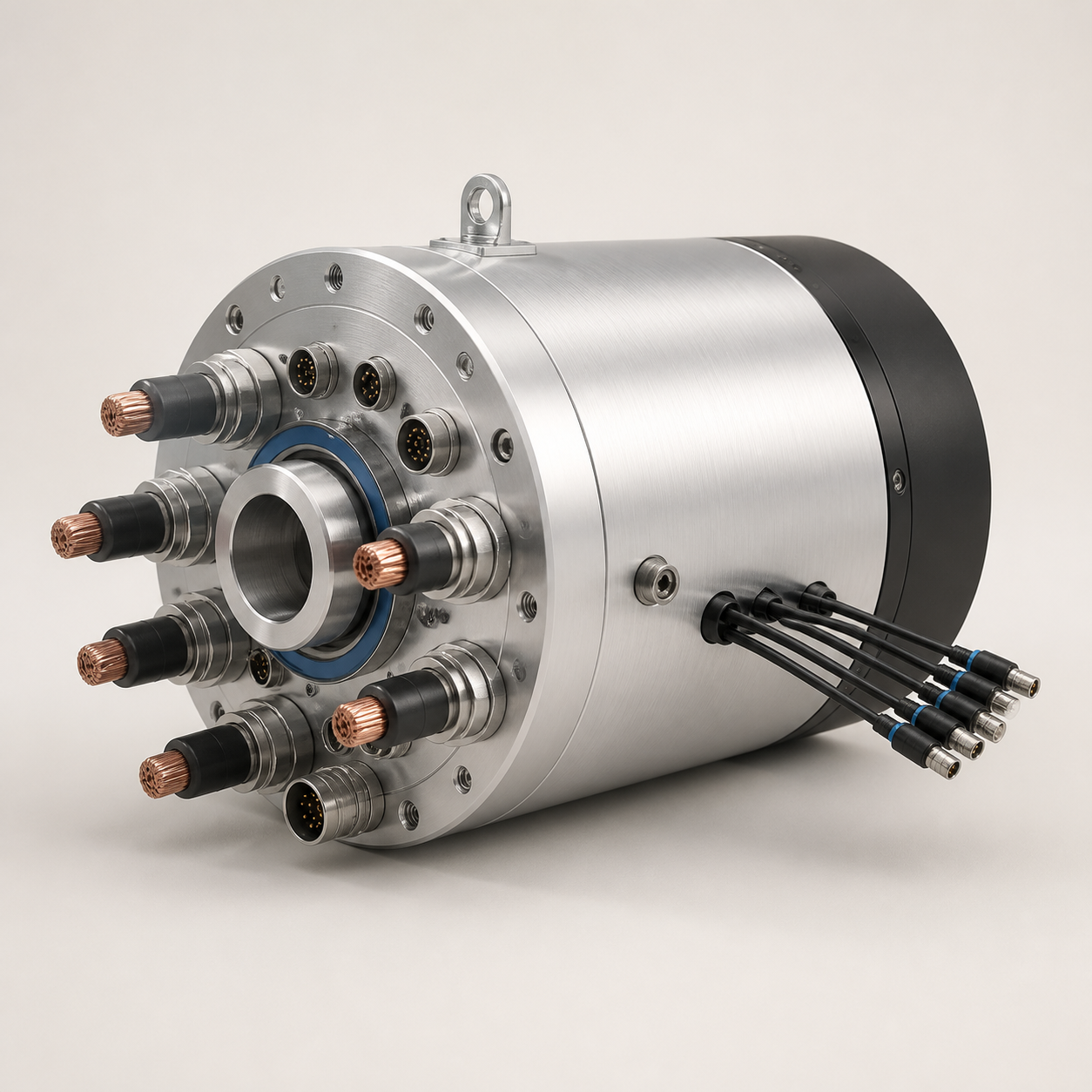 High-current solution
Energy transmission
A broad contact area and application-specific conductor geometry support high-current transmission with controlled temperature and stable contact resistance.
A wind turbine slip ring is considered wherever power and control connections are needed between stationary and rotating assemblies. In applications such as pitch systems, channel functions and load profiles must be clearly defined. Not every turbine uses the same architecture; installation, electrical connections and servicing methods depend on the system.
Include ambient temperature, humidity, vibration, speed range and maintenance access in the assessment. Specify continuous and peak currents separately, and list control signals and data protocols. For turbine-specific slip ring design , discuss target ingress protection and test conditions at the start. The high-current family provides a starting point for reviewing power requirements; final suitability depends on technical assessment and verification.
Let's discuss your energy project
Share the current, channels, protection rating and operating range. Core Slip engineers will help develop the right connection for your turbine architecture.
Get in touch